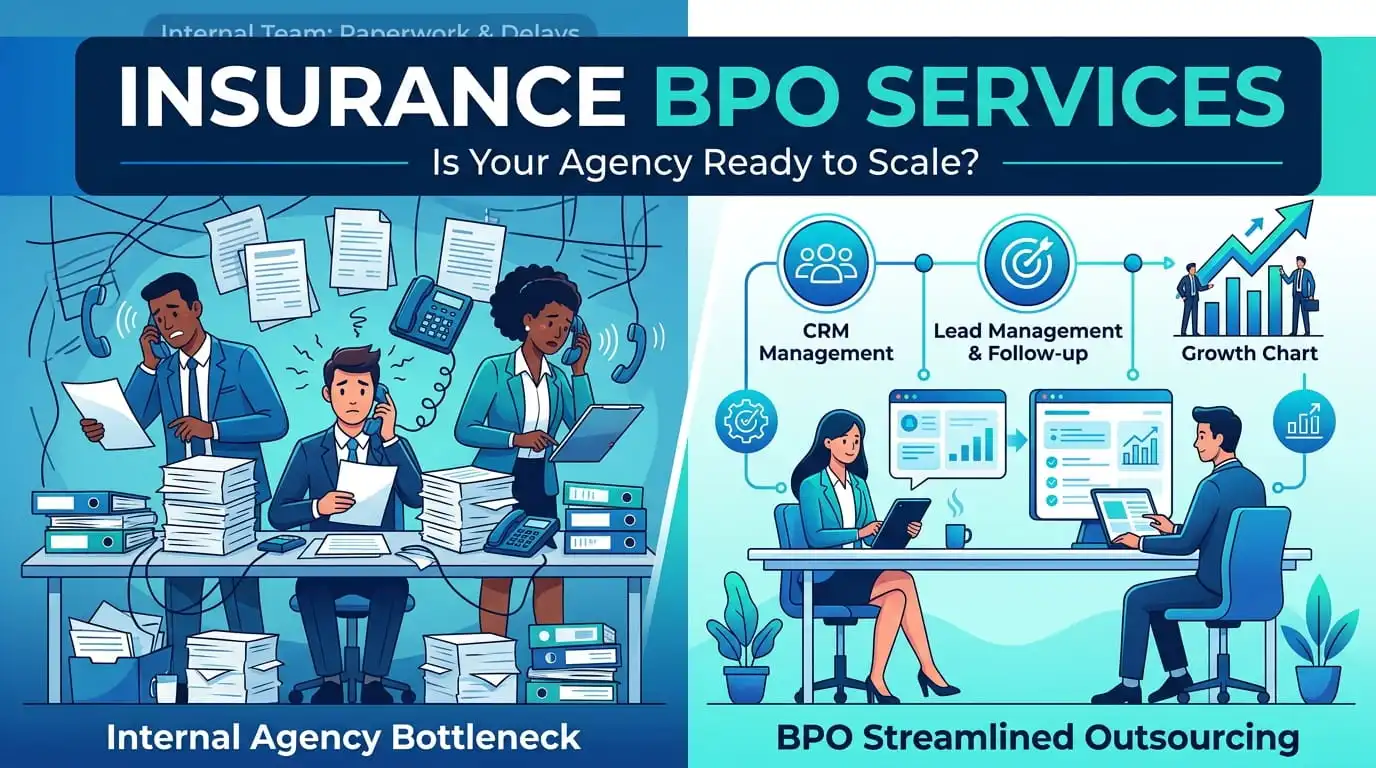
Insurance agencies can generate plenty of leads and still struggle to turn those leads into conversations with producers.
The problem is often not lead volume. It is what happens after a lead enters the pipeline.
New inquiries need to be contacted, followed up with, qualified, and moved toward a meaningful sales conversation. When producers are responsible for handling every step themselves, important leads can sit untouched while producers focus on existing clients, renewals, applications, and other revenue-generating activities.
An outsourced insurance sales development team can take responsibility for this part of the process.
Rather than simply hiring a call center to make outbound calls, agencies can build an outsourced sales development function that works as an extension of their internal sales operation.
The goal is straightforward:
Lead → Follow-Up → Qualification → Appointment → Producer → Opportunity
This guide explains how to structure that process.
What Is an Outsourced Insurance Sales Development Team?
An outsourced insurance sales development team is an external team responsible for activities that move potential insurance customers from initial interest toward a qualified sales conversation.
Depending on the agency’s model, the team may handle:
- New lead follow-up
- Inbound lead response
- Outbound prospecting
- Lead qualification
- Appointment setting
- Re-engagement of older leads
- CRM updates
- Follow-up scheduling
- Basic prospect information gathering
- Handoff of qualified opportunities to producers
The team does not replace the producer.
Instead, it handles the sales development work that happens before the producer needs to spend significant time with the prospect.
How to Build an Outsourced Insurance Sales Development Team
1. Define the Team’s Role Before Hiring
The first step is deciding exactly what the outsourced team will own.
A common mistake is starting with a vague requirement such as:
“Call our leads and set appointments.”
That does not provide enough direction.
A stronger model defines specific responsibilities and handoff points.
For example:
Marketing:
Generates leads.
Outsourced Sales Development Team:
Contacts, follows up with, qualifies, and schedules prospects.
Producer:
Handles the sales conversation and recommendation.
Agency:
Manages the quote, application, policy, and customer relationship.
This creates clear accountability throughout the funnel.
2. Define Your Ideal Lead
Not every lead should receive the same treatment.
Before the outsourced team begins contacting prospects, the agency should define what a valuable lead looks like.
Depending on the insurance product, this could include:
- Geographic location
- Insurance type
- Business or personal customer
- Company size
- Coverage requirements
- Existing insurance situation
- Renewal timing
- Purchase intent
- Estimated premium potential
- Decision-maker status
For example, a commercial insurance agency may prioritize business owners who need coverage within a specific timeframe, while a personal-lines agency may have different qualification criteria.
The outsourced team needs these rules before it starts making calls.
3. Create Clear Qualification Criteria
Lead qualification should not depend entirely on individual caller judgment.
Create a simple qualification framework that tells the team what information matters.
Basic Qualification
The team may need to determine:
- Is the prospect looking for insurance?
- What type of coverage do they need?
- Where are they located?
- Are they currently insured?
- When are they looking to make a change?
- Are they the decision-maker?
Sales Readiness
The team can also determine:
- Is there an active insurance need?
- Is the timing appropriate?
- Does the prospect meet the agency’s target profile?
- Are they willing to speak with a producer?
The exact questions should depend on the agency’s products and sales process.
The objective is not to conduct the entire insurance consultation. The objective is to determine whether the prospect is worth a producer’s time.
4. Build the Follow-Up Process
One of the biggest advantages of a dedicated sales development team is consistency.
Instead of relying on producers to remember which leads need another call, the outsourced team can operate according to a defined follow-up process.
The process should specify:
- When the first contact attempt happens
- How many attempts should be made
- Which communication channels are used
- When follow-up should occur
- What happens when the prospect does not answer
- How interested prospects are prioritized
- When a lead is considered inactive
- When an older lead should be re-engaged
This turns follow-up from an individual habit into an operational process.
5. Develop Scripts, But Do Not Make Conversations Robotic
A good outsourced sales development team needs structure without sounding scripted.
The agency should provide:
- Opening language
- Qualification questions
- Common objection responses
- Appointment-setting language
- Voicemail guidelines
- Follow-up messaging
- Escalation instructions
However, representatives should still be able to have natural conversations.
Insurance prospects may have different questions depending on their situation. A rigid script can make the interaction feel transactional.
The better approach is to give representatives a conversation framework and the information they need to respond appropriately.
6. Define What Counts as a Qualified Appointment
This is one of the most important decisions in the entire operation.
An appointment should not simply mean that someone agreed to speak with a producer.
The agency should define what makes an appointment genuinely valuable.
For example, a qualified appointment might require:
- The prospect matches the agency’s target customer profile
- The prospect has a relevant insurance need
- The prospect has expressed meaningful interest
- The appropriate decision-maker will attend
- The prospect has agreed to a specific meeting time
- Required information has been captured in the CRM
Clear appointment criteria prevent the outsourced team from optimizing for appointment volume at the expense of appointment quality.
7. Connect the Team to Your CRM
The outsourced team should work inside the agency’s existing sales workflow whenever possible.
The CRM should show:
- New leads
- Contact attempts
- Conversation outcomes
- Qualification status
- Follow-up dates
- Appointment status
- Notes
- Disposition reasons
- Producer assignments
This gives the agency visibility into what is happening with its leads.
It also prevents information from becoming trapped in spreadsheets, personal notes, or disconnected systems.
8. Establish a Producer Handoff Process
The handoff between sales development and the producer needs to be clear.
When an appointment is booked, the producer should know:
- Who the prospect is
- What type of insurance they are interested in
- Why they are looking
- Their current situation
- Their timing
- Relevant qualification information
- What was discussed during the initial conversation
This allows the producer to enter the conversation prepared instead of starting from zero.
The handoff should feel like a continuation of the conversation, not a new sales process.
9. Track the Right KPIs
An outsourced sales development team should be measured on more than calls made.
Useful metrics can include:
Activity Metrics
- Leads received
- Calls attempted
- Conversations
- Follow-up attempts
- Messages sent
Conversion Metrics
- Contact rate
- Qualified lead rate
- Appointment rate
- Appointment show rate
- Lead-to-opportunity conversion
Quality Metrics
- Qualified appointments
- Producer acceptance rate
- Appointment quality
- Disqualification rate
- Lead disposition accuracy
Business Metrics
- Opportunities created
- Policies sold
- Revenue generated
- Cost per qualified opportunity
- Return on sales development investment
The most important metrics should connect sales development activity to actual business outcomes.
10. Create a Quality Assurance Process
Outsourcing does not mean giving up control over customer interactions.
Agencies should establish a quality assurance process that regularly reviews:
- Calls
- Lead qualification
- CRM notes
- Appointment quality
- Script adherence
- Objection handling
- Handoff quality
Feedback should then be used to improve the process.
If producers repeatedly report that appointments are poorly qualified, the qualification criteria may need to change.
If prospects frequently object to a particular part of the conversation, the script or training may need to be adjusted.
This creates a continuous improvement cycle.
11. Start With a Focused Pilot
An agency does not necessarily need to outsource its entire sales development operation immediately.
A pilot can begin with:
- One insurance product
- One lead source
- A defined lead volume
- A small team
- A specific geographic market
- A limited qualification framework
The agency can then measure results before expanding.
This approach makes it easier to identify problems with lead quality, qualification, messaging, CRM workflows, or appointment criteria before scaling the operation.
12. Scale Based on Lead Volume
Once the process is working, the outsourced team can expand with the agency.
Scaling may involve:
- More representatives
- Longer coverage hours
- Additional lead sources
- Additional insurance products
- More aggressive re-engagement
- Additional qualification workflows
- Dedicated teams for different campaigns
The key is to scale a proven process rather than simply adding more callers.
More activity does not automatically create more opportunities if the underlying process is inefficient.
Common Mistakes to Avoid
Treating the Outsourced Team Like a Generic Call Center
The team should understand the agency’s target customers, products, qualification criteria, and sales process.
Measuring Only Call Volume
A high number of calls does not necessarily mean a high number of qualified opportunities.
Failing to Define Appointment Quality
Without clear criteria, the agency and outsourced team may have completely different definitions of success.
Poor CRM Integration
If the team cannot accurately record lead activity, producers lose visibility into the pipeline.
No Feedback From Producers
Producers are often the best source of information about appointment quality and lead readiness.
Their feedback should be incorporated into training, qualification criteria, and process improvements.
Changing the Process Too Often
The agency needs enough consistent data to determine what is working before making constant changes.
Frequent changes can make it difficult to identify which strategies are actually improving performance.
When Does an Outsourced Sales Development Team Make Sense?
An outsourced model may be particularly useful when an insurance agency:
- Generates more leads than producers can consistently follow up with
- Has inconsistent lead response
- Has a large database of older leads
- Wants producers focused on selling rather than prospecting
- Needs additional appointment-setting capacity
- Wants to expand without immediately building a large internal team
- Needs extended coverage for lead response
- Has a repeatable qualification process
The strongest candidates are usually agencies that already have a sales process but need more capacity and consistency at the top of the funnel.
What Should Stay With the Agency?
Outsourcing sales development does not mean outsourcing every part of sales.
The agency should generally retain ownership of:
- Product strategy
- Pricing
- Coverage recommendations
- Complex insurance questions
- Final sales conversations
- Quoting decisions
- Underwriting-related decisions
- Policy placement
- Customer relationships
The outsourced team should support the process leading into those activities.
This keeps specialized insurance expertise with the agency while allowing the sales development team to focus on moving qualified prospects forward.
The Goal Is a Sales Development System, Not Just More Calls
The real value of an outsourced insurance sales development team comes from creating a repeatable system.
The system should answer five questions:
- Who should we contact?
- How quickly should we contact them?
- How should we qualify them?
- When should we involve a producer?
- How do we measure the outcome?
When those answers are clearly defined, an outsourced team becomes much more than a group of people making calls.
It becomes a structured sales development function that helps the agency manage opportunities consistently.
Final Thoughts
Building an outsourced insurance sales development team starts with process, not headcount.
The agency needs clear lead definitions, qualification criteria, follow-up workflows, appointment standards, CRM processes, producer handoffs, and measurable KPIs.
Once those pieces are in place, an outsourced team can provide the capacity needed to execute the process consistently.
For insurance agencies, the objective is not simply to contact more people.
It is to make sure more of the right prospects receive timely follow-up, are properly qualified, and reach the producer at the right stage of the buying process.
Turn Your Insurance Leads Into Qualified Opportunities
DialForce helps insurance agencies manage the sales development work between lead generation and the producer.
Our team can support lead follow-up, lead qualification, appointment setting, and lead re-engagement, helping agencies create a more consistent process for moving prospects through the pipeline.
If your producers are spending too much time chasing leads instead of selling, an outsourced sales development team can help create a more efficient path from lead to appointment.
Talk to DialForce BPO about building a dedicated sales development process for your agency.