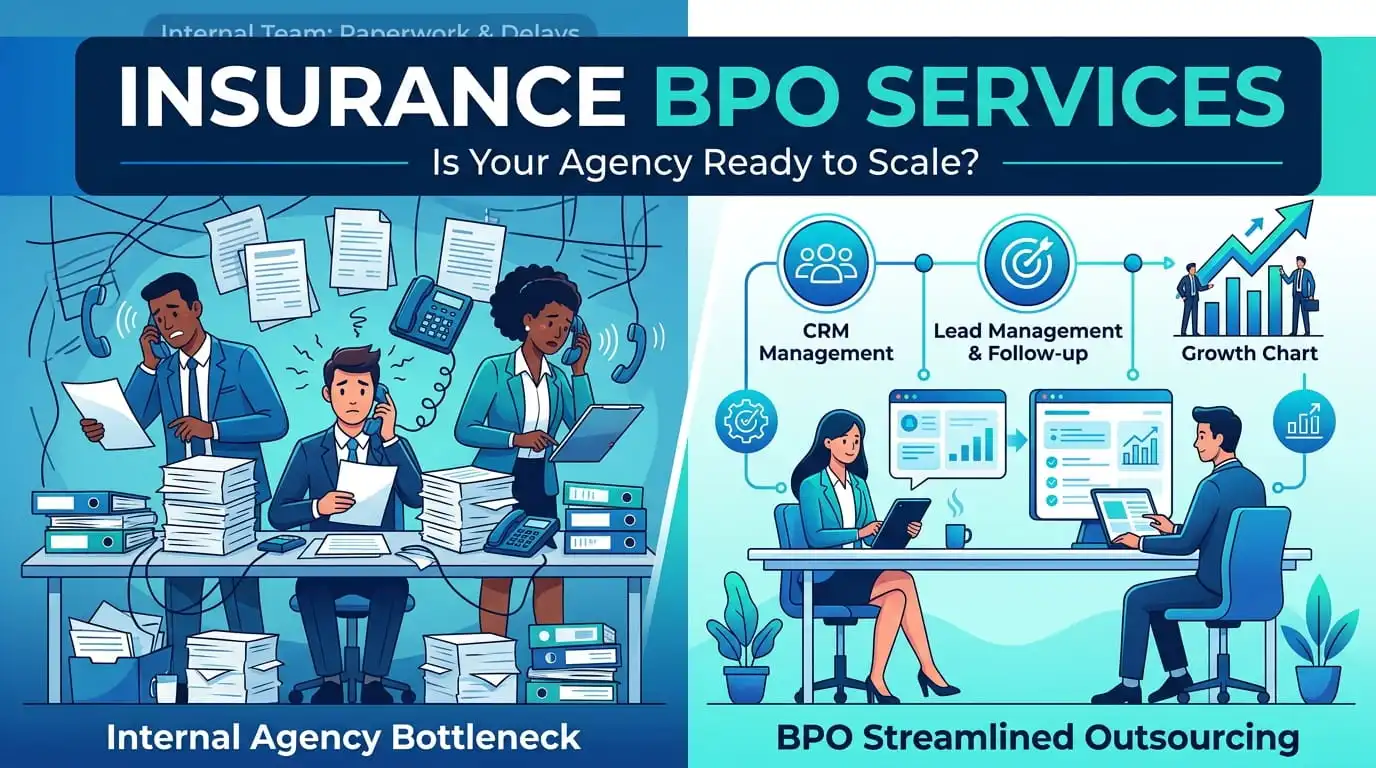
Insurance agencies are under constant pressure to generate new business while maintaining strong service for existing clients.
But as an agency grows, internal teams can quickly become overloaded. Producers may spend too much time following up with leads, staff may struggle to keep up with administrative work, and opportunities can be lost simply because there is not enough capacity to handle them.
This is where insurance BPO services can become valuable.
Business process outsourcing, or BPO, allows an insurance agency to delegate specific business functions to an external team. Instead of hiring internally for every role, an agency can use a specialized outsourced team to handle defined parts of its operation.
For some agencies, BPO can improve efficiency and create additional capacity. For others, outsourcing may not solve the underlying problem.
The important question is:
Does your insurance agency actually need BPO services?
Here are the signs to look for.
What Are Insurance BPO Services?
Insurance BPO services involve outsourcing specific business processes to an external service provider.
Depending on the agency and provider, outsourced functions can include:
- Lead follow-up
- Lead qualification
- Appointment setting
- Outbound prospecting
- Customer support
- Administrative tasks
- Data entry
- CRM management
- Policy-related administrative support
- Back-office operations
- Re-engagement of older leads
The right model depends on what is creating the most pressure inside the agency.
For agencies focused on growth, sales development functions such as lead follow-up, qualification, and appointment setting can be particularly valuable because they help producers spend more time on sales conversations.
1. Your Producers Are Spending Too Much Time Following Up With Leads
One of the clearest signs that an agency may need outsourcing is when producers are spending a significant amount of their time chasing prospects.
Producers are typically most valuable when they are having meaningful conversations with qualified prospects and customers.
If their day includes:
- Calling new leads repeatedly
- Leaving voicemails
- Sending follow-up messages
- Updating lead records
- Trying to reconnect with old prospects
- Scheduling basic appointments
then valuable selling time may be getting consumed by sales development activities.
An outsourced team can take responsibility for these activities and pass qualified opportunities to producers.
2. Leads Are Not Being Followed Up With Consistently
Lead generation only creates an opportunity.
The agency still needs a reliable process for turning that opportunity into a conversation.
If some leads receive immediate attention while others are contacted days later, the agency may have a process problem rather than a lead-generation problem.
Warning signs include:
- New leads sitting in the CRM
- Missed calls not being returned quickly
- Follow-up stopping after one or two attempts
- Different producers using different follow-up processes
- No clear ownership of unresponsive leads
An outsourced team can provide dedicated capacity for consistent lead follow-up.
3. Your Agency Has More Leads Than Your Team Can Handle
Growth can create an unusual problem: success generates more work.
An agency may increase marketing spend, launch new campaigns, purchase leads, or develop new referral channels.
But if internal staff cannot process the additional volume, lead generation becomes less effective.
For example:
Marketing generates 1,000 leads → Internal team can effectively work 600 → 400 leads receive inadequate attention
The issue is not necessarily the quality of the remaining leads. The agency may simply lack the capacity to work them properly.
BPO can provide additional sales development capacity without requiring the agency to immediately build a larger internal department.
4. You Have a Large Database of Older Leads
Many agencies have a valuable but neglected asset sitting inside their CRM: older leads.
These prospects may have:
- Requested information previously
- Received a quote
- Spoken with a producer
- Been interested but not ready
- Stopped responding
- Had a future renewal date
- Never completed the sales process
Instead of allowing these records to remain inactive indefinitely, an outsourced team can run structured re-engagement campaigns.
This gives the agency another opportunity to identify prospects who may now have an active insurance need.
5. Your Team Is Growing Faster Than Your Hiring Capacity
Hiring internal employees takes time.
The agency needs to:
- Recruit
- Interview
- Hire
- Train
- Manage
- Provide technology
- Monitor performance
And after all that, the agency still needs to maintain the team.
An outsourced model can provide access to an existing team and operating infrastructure.
This can be particularly useful when an agency needs additional capacity quickly or wants to test a new sales initiative before making a larger internal hiring commitment.
6. Your Agency Needs Extended Coverage
Insurance prospects do not necessarily submit inquiries only when your producers are available.
A lead may arrive:
- Early in the morning
- During lunch
- In the evening
- During a busy sales period
- While producers are in meetings
If nobody is responsible for responding during those periods, opportunities can wait.
An outsourced team can provide additional coverage based on the agency’s lead volume and operating requirements.
The goal is not simply to keep phones busy. It is to ensure that prospects have a clear path to the agency when they express interest.
7. Administrative Work Is Taking Time Away From Revenue-Producing Activities
BPO is not limited to sales.
Agencies may also outsource repetitive operational tasks that consume internal capacity.
Examples include:
- Data entry
- CRM updates
- Lead disposition
- Appointment coordination
- Record maintenance
- Basic administrative workflows
The principle is simple:
Keep specialized decisions with specialized employees, and consider outsourcing repeatable processes that do not require the same level of internal expertise.
8. You Need a More Consistent Sales Development Process
If every producer manages leads differently, the agency may struggle to create predictable results.
One producer might call immediately. Another might follow up tomorrow. Someone else might make two attempts and move on.
Over time, this creates an inconsistent customer experience and makes performance difficult to measure.
An outsourced sales development team can operate according to a defined process covering:
- Lead assignment
- Initial contact
- Follow-up
- Qualification
- Appointment setting
- CRM documentation
- Handoff to producers
- Lead re-engagement
This creates a repeatable operating model rather than relying entirely on individual habits.
9. You Want Producers Focused on Selling
One of the strongest reasons to consider BPO is producer productivity.
Imagine a producer’s day divided between two types of activities.
Sales Activities
- Speaking with qualified prospects
- Presenting insurance solutions
- Following up on active opportunities
- Closing business
Sales Development Activities
- Calling new leads
- Chasing unresponsive prospects
- Qualifying inquiries
- Scheduling appointments
- Updating CRM records
The second category may be necessary, but it does not always require the producer’s expertise.
Moving appropriate sales development activities to an outsourced team can allow producers to spend more of their time on higher-value conversations.
10. Your Agency Wants to Scale Without Building Every Function Internally
An agency does not necessarily need to build a large internal department for every operational requirement.
Outsourcing can provide access to specialized capacity without requiring the agency to create an entirely new function from scratch.
This can be useful when:
- Lead volume is increasing
- The agency is entering new markets
- Marketing campaigns are expanding
- Producers need additional support
- The agency wants to test a new sales channel
- Internal hiring is difficult
The outsourced team becomes an extension of the agency’s operation.
When BPO May Not Be the Right Choice
Outsourcing is not automatically the answer.
An agency may not need BPO if:
- Lead volume is very low
- Internal staff already has sufficient capacity
- The process is not yet clearly defined
- The agency has not identified what should actually be outsourced
- The work requires specialized expertise that must remain internal
- Management is not prepared to provide training and oversight
BPO works best when there is a clearly defined, repeatable process that an external team can execute effectively.
What Should an Insurance Agency Outsource?
The answer depends on the agency.
A useful way to evaluate potential BPO functions is to ask three questions.
Is the Process Repeatable?
If the same workflow happens repeatedly, it may be a good candidate for outsourcing.
Can the Process Be Clearly Documented?
The external team needs clear instructions, qualification criteria, workflows, and escalation rules.
Does the Task Require the Producer’s Expertise?
If the task requires a highly specialized insurance decision, it may belong with the agency.
If it is primarily administrative or sales development work, outsourcing may be worth considering.
BPO vs. Hiring an Internal Team
The decision often comes down to the agency’s specific needs.
| Consideration | Internal Team | Outsourced Team |
|---|---|---|
| Hiring | Agency manages recruiting | Provider manages staffing |
| Training | Agency-owned | Shared with provider |
| Management | Internal | Shared/provider-managed |
| Scaling | Requires additional hiring | Capacity can often be adjusted |
| Infrastructure | Agency provides it | Provider typically provides much of it |
| Process control | High | Requires defined processes |
| Specialized agency knowledge | Strong | Requires training and documentation |
| Operational flexibility | Depends on staffing | Often easier to adjust |
Neither model is universally better.
The right choice depends on lead volume, budget, growth plans, internal management capacity, and the type of work being outsourced.
How to Choose an Insurance BPO Provider
If your agency decides to outsource, provider selection becomes critical.
Look for a partner that understands the difference between generic call-center activity and insurance sales development.
Consider whether the provider can support the following:
Insurance-Specific Workflows
The team should understand the agency’s products, target customers, qualification criteria, and escalation requirements.
CRM Integration
The team should be able to work within your existing sales process and keep lead records accurate.
Quality Assurance
There should be a process for reviewing conversations, appointments, lead qualification, and overall performance.
Transparent Reporting
You should be able to see what is happening with your leads and understand the outcomes.
Flexible Capacity
The provider should be able to support changes in lead volume as your agency grows.
Clear Handoffs
Qualified opportunities should reach producers with enough context to make the next conversation productive.
Start With One Process
An agency does not need to outsource everything.
A better approach is often to identify the process creating the biggest bottleneck.
For a growth-focused insurance agency, that might be:
New Lead → Follow-Up → Qualification → Appointment
The agency can outsource that workflow, measure the results, and determine whether additional functions should be added later.
This makes the transition easier to manage and provides a clearer way to evaluate the business impact.
The Most Important Question: Where Is Your Bottleneck?
Before choosing an insurance BPO provider, look at where opportunities are being lost.
Ask yourself:
- Are leads not being contacted quickly enough?
- Are producers spending too much time on unqualified prospects?
- Are old leads sitting untouched?
- Are appointments not being scheduled consistently?
- Is administrative work consuming producer capacity?
The answer will help determine what should be outsourced.
BPO should solve a specific operational problem, not become an outsourcing exercise for its own sake.
Final Thoughts
Insurance BPO services can help agencies add capacity, create more consistent processes, and allow internal teams to focus on the work that requires their expertise.
But outsourcing should start with a clear business problem.
If your agency has leads that are not being followed up with, producers spending too much time on sales development, or a growing pipeline that your current team cannot effectively manage, an outsourced team may be worth considering.
The best BPO model is not necessarily the one that outsources the most work.
It is the one that puts the right work with the right team.
Build a Stronger Insurance Lead Conversion Process
DialForce helps insurance agencies handle the sales development activities that happen between lead generation and the producer conversation.
Our team can support lead follow-up, lead qualification, appointment setting, and lead re-engagement, helping agencies create a consistent process for managing opportunities.
If your agency has the leads but not enough capacity to work them consistently, outsourcing part of your sales development process may be the next step.