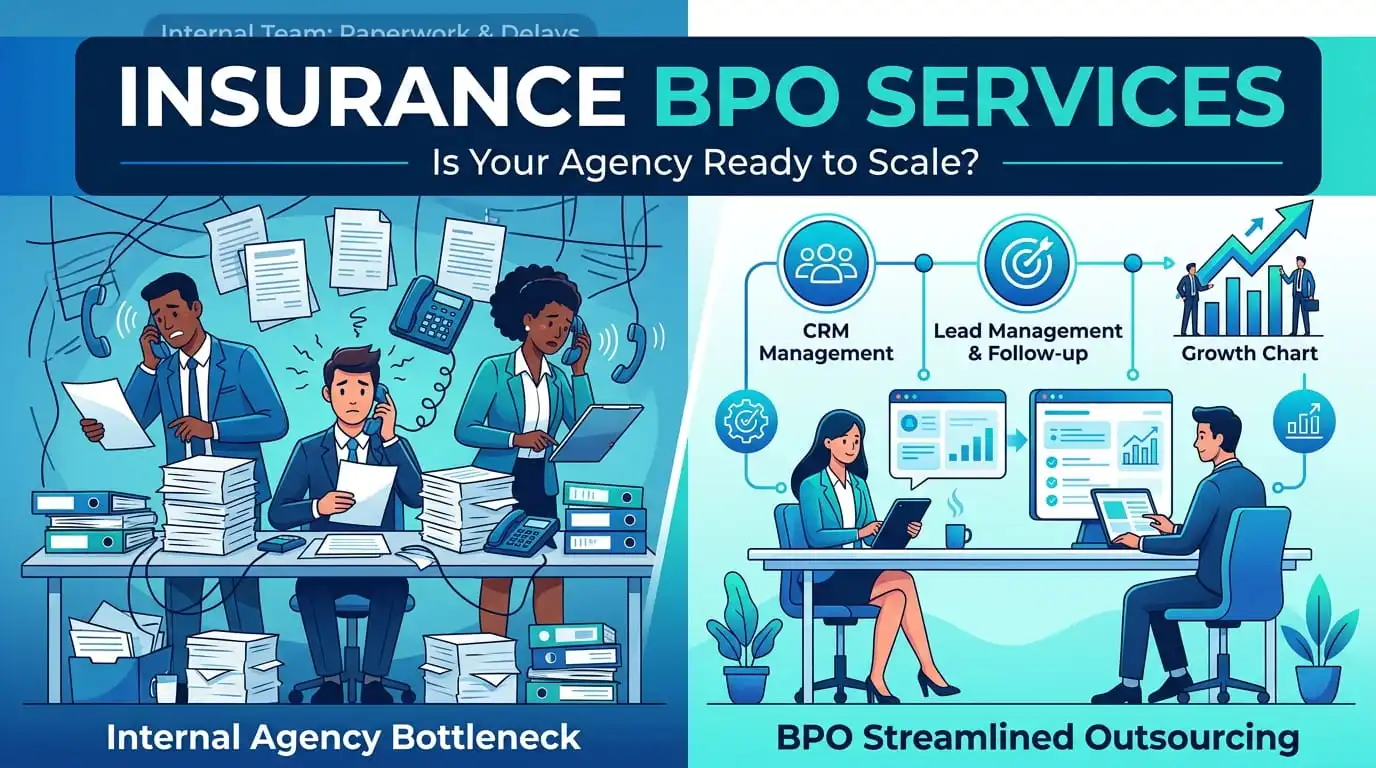
Insurance agencies invest heavily in generating leads, but generating a lead is only the beginning of the sales process.
The real challenge is turning those leads into conversations with qualified prospects.
When producers are responsible for calling every new lead, following up with prospects, qualifying opportunities, and scheduling appointments, valuable sales time can quickly disappear. Some leads may receive a quick call with no further follow-up, while others may never get contacted at all.
This is why more insurance agencies are considering outsourced appointment setting.
An outsourced appointment-setting team can handle lead follow-up, qualify prospects based on your criteria, and schedule appointments directly onto your producers’ calendars.
The result is a more organized process between lead generation and the sales conversation.
In this guide, we’ll explain how insurance agencies can outsource appointment setting, what an outsourced team can handle, how to choose the right partner, and what to look for before making a decision.
What Is Insurance Appointment Setting?
Insurance appointment setting is the process of contacting potential customers, understanding their needs, determining whether they are a good fit, and scheduling a conversation with an insurance agent or producer.
The appointment setter typically does not replace the producer or licensed insurance professional. Instead, they handle the activities that happen before the sales conversation.
A typical process looks like this:
Lead Generated → Lead Follow-Up → Lead Qualification → Appointment Set → Producer Conversation → Quote → Customer
For many agencies, the biggest opportunity is improving the middle of this funnel.
You may already have a consistent source of leads. The question is whether your team has the capacity to consistently follow up with those leads and turn qualified prospects into appointments.
Why Insurance Agencies Outsource Appointment Setting
There are several reasons an insurance agency may decide to outsource appointment setting.
1. Producers Don’t Have Enough Time
Insurance producers need to spend their time on activities that require their expertise, including:
- Speaking with qualified prospects
- Reviewing coverage
- Preparing quotes
- Explaining policies
- Building relationships
- Closing business
- Managing high-value opportunities
When producers spend hours every week calling new leads who may not answer, they have less time for actual sales conversations.
An outsourced appointment-setting team can take responsibility for much of that initial outreach and follow-up, allowing producers to focus on qualified opportunities.
2. Leads Aren’t Being Followed Up With Consistently
A common problem isn’t a lack of leads. It’s inconsistent follow-up.
A lead may come in while an agent is:
- Meeting with a client
- Handling a renewal
- Working on a quote
- Away from the office
- Dealing with administrative tasks
By the time someone gets around to calling, the prospect may have already contacted another agency.
An outsourced team provides dedicated capacity for lead follow-up, helping agencies create a more consistent sales process.
3. Your Agency Is Generating More Leads Than Your Team Can Handle
Lead volume is a good problem to have—until your sales team can’t keep up.
If your agency suddenly starts receiving hundreds of leads every month, adding more leads won’t necessarily produce more customers if those leads aren’t being contacted and qualified.
Instead of immediately expanding internal headcount, outsourcing can provide additional sales-development capacity.
4. You Have Old Leads Sitting in Your CRM
Many insurance agencies have hundreds or thousands of older leads sitting in their CRM.
Some of those prospects may have never been reached. Others may have been interested but weren’t ready at the time.
An outsourced team can help create dedicated lead re-engagement campaigns to identify prospects who may still have an insurance need.
What Does an Outsourced Insurance Appointment-Setting Team Do?
The exact scope depends on the provider and your agreement, but an effective appointment-setting partner can support several stages of the sales process.
Lead Follow-Up
The team contacts new leads according to your defined follow-up process.
This may include:
- Initial phone calls
- Follow-up calls
- Voicemails
- SMS where appropriate
- Email follow-up
- Lead re-engagement
The goal is to increase the number of leads that turn into actual conversations.
Lead Qualification
Before sending a prospect to a producer, the team can ask predetermined qualification questions.
Depending on your insurance business, qualification may involve:
- Type of insurance needed
- Location
- Current coverage
- Renewal timing
- Business or personal insurance needs
- Level of interest
- Buying timeline
- Other agency-specific criteria
The qualification process should be built around the criteria your agency defines.
Appointment Scheduling
Once a prospect meets your qualification criteria and is interested in moving forward, the appointment setter schedules the next conversation.
That could be:
- A phone appointment
- A video meeting
- An in-person meeting
- A quote consultation
- A coverage review
The objective is to make it easy for the qualified prospect and producer to connect.
Appointment Confirmation
A good appointment-setting process doesn’t stop when the appointment is booked.
Confirmation messages and reminders can help reduce unnecessary no-shows and improve appointment show rates.
CRM Updates
The outsourced team should also maintain accurate lead records based on the agreed workflow.
For example:
| Lead Stage | Status |
|---|---|
| New Lead | Needs follow-up |
| Contacted | Follow-up scheduled |
| Connected | Conversation completed |
| Qualified | Ready for appointment |
| Appointment Set | Producer assigned |
| No Response | Follow-up continues |
| Not Ready | Future follow-up |
| Disqualified | Removed from active pipeline |
This gives your internal team visibility into what is happening with every lead.
How to Outsource Insurance Appointment Setting
Outsourcing works best when the process is clearly defined before the first lead is contacted.
Step 1: Define Your Ideal Customer
Start by identifying who you actually want appointments with.
For example, your agency may focus on:
- Personal lines
- Commercial insurance
- Life insurance
- Health insurance
- Medicare
- Property and casualty insurance
- Specialty insurance
You should also define geographic, demographic, business, or other criteria that determine whether a lead is a good fit.
The clearer your target customer profile, the easier it is for an outsourced team to qualify leads correctly.
Step 2: Define What Makes a Lead Qualified
Don’t simply tell the appointment-setting company to “book appointments.”
Give them clear qualification criteria.
For example:
A qualified prospect is someone who needs the type of coverage we provide, is located within our service area, is interested in discussing options, and meets our agreed qualification criteria.
Your qualification criteria will vary by agency and insurance product.
The more specific the criteria, the more useful the appointments will be for your producers.
Step 3: Establish Your Follow-Up Process
Determine what happens when a new lead arrives.
For example:
New Lead
↓
First Contact Attempt
↓
Second Follow-Up
↓
Qualification
↓
Appointment
↓
Confirmation
↓
Producer
You should also establish what happens when the prospect doesn’t answer.
A structured follow-up process is far more reliable than expecting individual producers to remember which leads they need to call next.
Step 4: Give the Team the Right Scripts
Your outsourced team needs a conversation framework.
The script should help them:
- Introduce themselves
- Explain why they’re calling
- Confirm the prospect’s interest
- Ask qualification questions
- Understand the prospect’s needs
- Handle common objections
- Explain the next step
- Schedule an appointment
The script shouldn’t make conversations sound robotic.
Instead, it should provide consistency while allowing the representative to have a natural conversation.
Step 5: Connect Your CRM and Calendar
Your appointment-setting process should fit into the systems your agency already uses.
Ideally, the outsourced team should have a defined process for:
- Receiving new leads
- Updating lead status
- Recording contact attempts
- Recording qualification information
- Scheduling appointments
- Assigning producers
- Updating appointment outcomes
The less manual work your internal team has to do, the more valuable the outsourcing relationship becomes.
Step 6: Establish KPIs
Don’t evaluate an appointment-setting partner simply by the number of calls they make.
Measure the outcomes.
Important metrics may include:
- Lead response time
- Contact rate
- Conversation rate
- Qualification rate
- Appointment booking rate
- Appointment show rate
- Cost per appointment
- Number of qualified appointments
- Lead-to-opportunity rate
- Opportunity-to-customer rate
The ultimate goal isn’t more calls.
It’s more qualified sales opportunities.
What Should You Look for in an Insurance Appointment-Setting Partner?
Choosing an outsourcing partner requires more than comparing prices.
The cheapest provider may not generate the best appointments.
Here are some factors to evaluate.
Insurance Industry Experience
Look for a team that understands the insurance sales process and can work within the qualification framework your agency provides.
They should understand that different insurance products require different conversations.
Lead Follow-Up Capability
Appointment setting starts with getting prospects on the phone.
Ask how the provider handles:
- New leads
- Missed connections
- Multiple follow-ups
- Old leads
- Unresponsive prospects
- Lead reactivation
Lead Qualification
Ask exactly how they determine whether a prospect is qualified.
You should be able to define your qualification criteria rather than accepting a generic process.
Appointment Quality
A high appointment count doesn’t necessarily mean good performance.
Ask:
What percentage of booked appointments meet our qualification criteria?
And:
What percentage of booked appointments actually show up?
Quality matters more than raw appointment volume.
Reporting
You should have visibility into what happens to your leads.
A good reporting process should help you understand:
- How many leads were received
- How many were contacted
- How many were reached
- How many were qualified
- How many appointments were booked
- How many appointments showed
- What happened to the remaining leads
Scalability
Your partner should be able to adapt as your agency grows.
Consider questions such as:
- If your lead volume doubles, can they handle it?
- If you launch a new insurance product, can the qualification process be updated?
- If you expand into another market, can the team support it?
These questions matter when you’re building a long-term partnership.
Outsourced Appointment Setting vs. Hiring In-House
Insurance agencies typically have two options when they need additional sales-development capacity: build an internal team or outsource the function.
In-House
An internal team gives you direct control, but it also comes with additional responsibilities.
You may need to handle:
- Recruiting
- Hiring
- Training
- Payroll
- Benefits
- Management
- Performance monitoring
- Employee turnover
- Technology
- Quality assurance
Outsourced
With an outsourced partner, the provider manages much of the operational infrastructure.
This can allow an agency to access a dedicated team without building the entire function internally.
The right choice depends on your agency’s size, lead volume, budget, management capacity, and long-term goals.
When Should an Insurance Agency Outsource Appointment Setting?
Outsourcing may be worth considering if you recognize several of these situations:
- Your agency is generating more leads than your producers can handle
- Leads aren’t being contacted quickly
- Producers spend too much time chasing prospects
- Follow-up is inconsistent
- Your CRM contains a large number of untouched leads
- Your team struggles to qualify leads consistently
- Appointment volume is lower than expected
- Producers are spending valuable time on unqualified prospects
- You want to increase sales capacity without immediately hiring more employees
- You need a dedicated team focused on lead conversion
You don’t need to wait until your sales process is completely overwhelmed.
In many cases, outsourcing can be used proactively to create additional capacity as the agency grows.
How Much Does Insurance Appointment-Setting Outsourcing Cost?
The cost depends on several factors, including:
- Lead volume
- Number of representatives
- Scope of services
- Calling volume
- Follow-up frequency
- Qualification requirements
- CRM requirements
- Appointment volume
- Reporting requirements
- Geographic coverage
Some providers charge per hour, while others use monthly retainers, per-lead pricing, per-appointment pricing, or other structures.
Instead of comparing price alone, compare the cost per qualified appointment and the revenue generated from those opportunities.
For example, a lower-cost provider that produces poorly qualified appointments may ultimately be more expensive than a higher-quality provider that consistently produces valuable sales opportunities.
How to Measure the ROI of Outsourced Appointment Setting
The easiest way to evaluate an appointment-setting program is to connect its activity to revenue.
Consider tracking:
Leads → Qualified Leads → Appointments → Shows → Opportunities → Customers → Revenue
For example, suppose an agency receives 500 leads.
If an outsourced team helps turn those leads into:
- 150 conversations
- 75 qualified prospects
- 50 appointments
- 40 completed appointments
- 20 sales opportunities
- 8 new customers
The agency can compare the revenue generated from those customers against the cost of the outsourced program.
This provides a much clearer picture than simply asking how many calls were made.
Common Mistakes When Outsourcing Appointment Setting
Choosing a Provider Based Only on Price
The cheapest service isn’t necessarily the best value.
Focus on appointment quality, process, communication, and measurable outcomes.
Not Defining Qualification Criteria
If your provider doesn’t know what makes a prospect qualified, you may receive appointments that aren’t useful to your producers.
Treating Appointment Setting as a One-Call Process
Many prospects won’t answer the first time.
A structured follow-up process is essential for maximizing contact and conversion rates.
Failing to Track Results
Without reporting, you can’t determine whether outsourcing is improving your sales funnel.
Expecting the Outsourced Team to Replace Your Producers
The purpose of appointment setting is usually to support your producers, not replace them.
The outsourced team creates more opportunities for producers to have productive sales conversations.
A Better Insurance Sales Process
The most effective outsourced appointment-setting model creates a clear division of responsibilities.
Marketing
Generates leads.
Outsourced Team
Follows up with leads.
Outsourced Team
Qualifies prospects.
Outsourced Team
Books qualified appointments.
Producer
Has the sales conversation.
Producer
Provides the quote or recommendation.
Agency
Closes and services the customer.
This allows each part of the organization to focus on what it does best.
Final Thoughts
Insurance agencies don’t always need more leads.
Sometimes they need to do more with the leads they already have.
When producers are responsible for every stage of the process, leads can go untouched, follow-up can become inconsistent, and valuable sales time can be lost.
Outsourcing appointment setting gives agencies another option.
A dedicated team can handle lead follow-up, qualification, appointment setting, and re-engagement, while producers focus on qualified prospects and closing business.
The right outsourcing partner should function as an extension of your sales team, not simply as a company making calls.
The goal is simple:
More leads contacted.
More prospects qualified.
More appointments booked.
More opportunities for your producers.
Turn More Insurance Leads Into Qualified Appointments
DialForce BPO helps U.S. insurance agencies handle the work between lead generation and the sales conversation.
Our team can help with lead follow-up, lead qualification, appointment setting, and lead re-engagement, giving your producers more opportunities to speak with qualified prospects.
If your agency is generating leads but your team doesn’t have the capacity to consistently follow up and book appointments, DialForce BPO can help.
Ready to turn more of your leads into sales conversations?