Generating insurance leads is only the first step. The real challenge for many insurance agencies is turning those leads into conversations, appointments, quotes, and ultimately customers.
Whether your agency gets leads from paid advertising, online quote forms, referrals, comparison websites, or other lead-generation channels, your results depend heavily on what happens after the lead comes in.
A lead that sits untouched for hours or receives one call and is never contacted again can quickly become a missed sales opportunity.
The good news is that improving insurance lead conversion doesn’t always require generating more leads. In many cases, agencies can increase revenue simply by building a better system for lead follow-up, qualification, and appointment setting.
In this guide, we’ll cover practical strategies insurance agencies can use to convert more leads into customers.
Why Insurance Leads Don’t Convert
Before improving your conversion rate, it helps to understand why leads fail to become customers. Common problems include:
- Slow response times
- Inconsistent follow-up
- Calling a lead only once
- Poor lead qualification
- Lack of a structured follow-up process
- Sales representatives spending time on unqualified prospects
- Weak communication scripts
- Poor appointment-setting processes
- Leads being forgotten or lost in a CRM
- No system for re-engaging older leads
The problem isn’t always the quality of the lead. Sometimes the problem is what happens after the lead arrives.
An agency can spend thousands of dollars generating leads but lose potential customers because nobody consistently follows up with them.
1. Respond to New Insurance Leads Quickly
Speed matters.
When someone submits an insurance quote request or expresses interest in coverage, they may also be contacting several other agencies. The longer you wait to respond, the more opportunities the prospect has to move on.
Your goal should be to create a process where new leads are contacted as quickly as possible during your operating hours.
A strong process might look like:
New lead → Immediate notification → First call → Follow-up attempt → Qualification → Appointment or quote
The important point is that lead response shouldn’t depend on whether a salesperson happens to notice a notification. It should be part of a defined process.
Why speed-to-lead matters
A prospect who just requested an insurance quote is typically more engaged than someone who submitted a form several days ago. That makes the first few minutes and hours particularly valuable.
Instead of asking:
“Did our agent see the lead?”
Your organization should be asking:
“How quickly did we contact the lead, and what happened next?”
That shift from individual responsibility to a repeatable process can make a significant difference.
2. Build a Consistent Lead Follow-Up Process
One of the biggest mistakes insurance agencies make is treating the first call as the entire follow-up strategy.
A prospect may not answer because they’re:
- Working
- Driving
- Busy with family
- Screening unknown numbers
- In a meeting
- Simply not ready to talk
No response doesn’t necessarily mean no interest. That’s why insurance agencies need a structured follow-up cadence.
For example:
- Day 1:
- Initial call
- Second call later in the day
- Text or email follow-up where appropriate
- Day 2–3:
- Additional call attempts
- Short follow-up message
- Day 4–7:
- Continue targeted follow-up
- Provide a reason for the prospect to respond
- Following weeks:
- Re-engage qualified but unresponsive leads
The exact cadence should depend on your lead source, product, compliance requirements, and sales process. The key is consistency.
3. Use Multiple Communication Channels
Not every prospect wants to communicate the same way. Some people prefer phone calls. Others are more responsive to text messages or email.
For that reason, consider building a coordinated follow-up process using channels such as:
- Phone
- SMS
- Voicemail
However, don’t turn your follow-up process into a flood of generic messages. Every communication should have a purpose.
For example:
“Hi Sarah, this is John from ABC Insurance. I’m following up on the quote request you submitted. I have a couple of questions so we can make sure we’re looking at the right coverage. Would you have a few minutes today?”
That’s more useful than simply sending:
“Just following up.”
4. Qualify Insurance Leads Before Passing Them to Producers
Not every lead deserves the same amount of sales time. Your team needs a way to determine which prospects are a good fit and which ones aren’t ready or don’t meet your criteria.
Lead qualification can help identify factors such as:
- Insurance need
- Coverage type
- Current policy
- Renewal timing
- Location
- Business or personal insurance needs
- Budget considerations
- Decision-making timeline
- Existing coverage
- Other relevant qualification criteria
The exact questions should be determined by the insurance products and customers your agency serves. The goal isn’t to interrogate the prospect; the goal is to understand whether there is a legitimate sales opportunity.
Better qualification means better use of sales time
Imagine a producer receives 50 new leads. If the producer has to personally call every lead, ask basic qualifying questions, chase unresponsive prospects, and schedule meetings, a significant amount of time can disappear before they ever get to the highest-value opportunities.
A structured qualification process can help separate:
Lead → Qualified lead → Sales opportunity
That allows producers to focus more of their time on prospects who are ready for a meaningful conversation.
5. Create Better Insurance Lead Follow-Up Scripts
Your team doesn’t need to sound robotic, but they do need a consistent framework.
A good insurance follow-up conversation should generally:
- Introduce the agency and representative
- Confirm why the prospect is being contacted
- Ask relevant questions
- Understand the prospect’s needs
- Determine whether the prospect is qualified
- Explain the next step
- Book an appointment or move the prospect forward
For example:
“Hi Mike, this is Sarah with ABC Insurance. You recently requested information about auto insurance. I wanted to learn a little more about what you’re looking for and see if we can help. Do you have a minute?”
The objective isn’t necessarily to sell the policy during the first interaction. Often, the first objective is simply to start the conversation.
6. Focus on Booking the Next Step
Another common mistake is trying to complete the entire sales process during the first call. For many insurance products, the better objective may be to move the prospect to the next stage.
That could mean:
- A quote discussion
- A coverage review
- A consultation
- A call with a licensed agent
- A policy review
- A scheduled follow-up
Instead of asking:
“Can I sell this person a policy right now?”
Ask:
“What is the next step that moves this prospect closer to becoming a customer?”
That mindset makes appointment setting an important part of insurance lead conversion.
7. Re-Engage Old Insurance Leads
Your CRM may contain a valuable asset that your agency is overlooking: old leads.
Some prospects weren’t ready when they first contacted you. Their situation may have changed. They may now be:
- Approaching renewal
- Looking for better rates
- Starting a business
- Buying a home
- Adding a vehicle
- Changing jobs
- Experiencing a major life event
- Reviewing their existing coverage
Instead of allowing old leads to disappear into your CRM, create a re-engagement campaign.
For example:
“Hi David, this is James from ABC Insurance. We spoke a while back when you were looking at your coverage. I wanted to check in and see if you’re still with the same provider or if you’d be open to reviewing your options.”
The key is to give the prospect a legitimate reason to reconnect.
8. Track Lead-to-Customer Conversion, Not Just Lead Volume
Many agencies focus heavily on how many leads they generate. But lead volume alone doesn’t tell you whether your marketing and sales process is working.
You should track the entire funnel:
Leads generated
↓
Leads contacted
↓
Leads reached
↓
Qualified leads
↓
Appointments booked
↓
Appointments completed
↓
Quotes
↓
Policies sold
↓
Customers
This gives you much better visibility into where opportunities are being lost.
Important insurance lead conversion metrics
Consider tracking:
- Lead response time
- Contact rate
- Qualification rate
- Appointment-booking rate
- Appointment show rate
- Quote rate
- Close rate
- Cost per qualified lead
- Cost per appointment
- Cost per acquisition
- Revenue per lead
If you generate 1,000 leads but only 100 become meaningful sales opportunities, your biggest growth opportunity may not be generating another 1,000 leads. It may be improving what happens to the existing 1,000.
9. Don’t Let Producers Spend All Day Chasing Leads
Producers are valuable sales resources. Their time is often better spent having conversations with qualified prospects, reviewing coverage, preparing proposals, and closing business than repeatedly calling leads who haven’t responded.
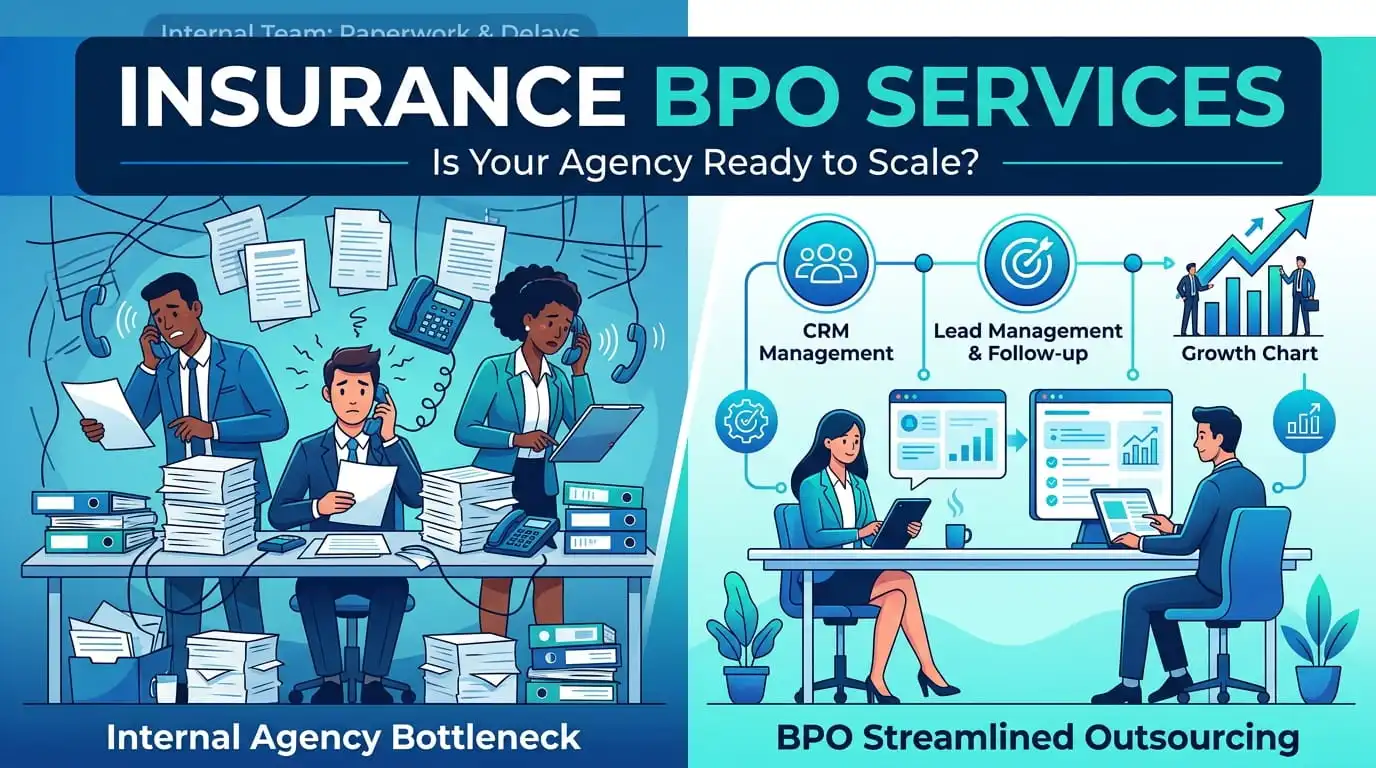
That’s where a dedicated lead follow-up and qualification function can help. An outsourced team can handle activities such as:
- Initial lead outreach
- Follow-up calls
- Lead qualification
- Appointment setting
- CRM updates
- Re-engagement campaigns
- Follow-up scheduling
This creates a bridge between marketing-generated leads and producer conversations. Instead of sending every lead directly to a producer, your agency can create a process like:
Marketing → Lead Follow-Up → Qualification → Appointment → Producer → Customer
10. Use Your CRM as a Sales System, Not Just a Database
A CRM should help your team know what needs to happen next. Every lead should have a clear status and next action.
| Lead Status | Next Action |
| New | Contact immediately |
| Contacted | Schedule next follow-up |
| Qualified | Book appointment |
| Appointment booked | Confirm appointment |
| No response | Continue follow-up |
| Not ready | Add to nurture campaign |
| Lost | Determine reason and re-engage later |
Without clear stages and next actions, leads can easily fall through the cracks. Your CRM should make it difficult for a qualified lead to disappear without someone noticing.
11. Improve Your Appointment Show Rate
Booking an appointment isn’t the same as having a sales conversation. If prospects regularly book but don’t show, you’re losing opportunities further down the funnel.
Improve show rates by:
- Confirming appointments
- Sending reminders
- Making the appointment value clear
- Offering easy rescheduling
- Confirming the prospect still has a need
- Keeping the time between booking and appointment reasonable
A simple confirmation message can help:
“Hi Sarah, just confirming your insurance review with John tomorrow at 2 PM. If anything changes, let us know and we’ll be happy to reschedule.”
Small operational improvements can compound across hundreds of appointments.
12. Give Prospects a Reason to Talk to You
Insurance prospects don’t necessarily want another sales pitch; they want help solving a problem. Your messaging should focus on the prospect’s situation.
- Instead of: “We offer great insurance products.”
- Try: “Let’s review your current coverage and see whether there are options that better fit your needs.”
The conversation should be about the prospect, not your agency. That means asking good questions and listening carefully.
13. Build a System That Works Even When Your Team Is Busy
Lead follow-up often breaks down during busy periods. Your producers may be:
- Meeting clients
- Handling renewals
- Preparing quotes
- Managing existing accounts
- Out of the office
- Dealing with administrative work
But leads continue arriving. A scalable agency needs a process that doesn’t depend entirely on individual employees remembering to follow up.
That could involve:
- Automated lead routing
- CRM workflows
- Notifications
- Dedicated appointment setters
- Outsourced lead follow-up
- Defined follow-up cadences
- Performance dashboards
The objective is simple: Every lead gets an appropriate response and a clear next step.
How to Build a High-Converting Insurance Lead Funnel
A strong insurance lead conversion process can be summarized as:
- Step 1: Generate the lead — Capture leads through advertising, referrals, website forms, quote requests, partnerships, or other channels.
- Step 2: Respond quickly — Contact the prospect while their interest is still fresh.
- Step 3: Follow up consistently — Don’t stop after one unanswered call.
- Step 4: Qualify the prospect — Determine whether the lead fits your target customer profile and has a legitimate insurance need.
- Step 5: Book the next conversation — Move qualified prospects into an appointment or sales conversation.
- Step 6: Confirm the appointment — Reduce no-shows with reminders and clear communication.
- Step 7: Let the producer sell — Give your licensed sales professionals more opportunities to speak with qualified prospects.
- Step 8: Re-engage — Don’t abandon leads that aren’t ready today.
This creates a repeatable system:
Lead → Contact → Qualification → Appointment → Sales Conversation → Customer
Should You Outsource Insurance Lead Follow-Up?
For some agencies, managing lead follow-up internally works well. For others, producers and agents simply don’t have enough time to consistently contact, qualify, and schedule every opportunity.
Outsourcing can make sense when an agency:
- Receives more leads than its team can handle
- Has inconsistent lead response times
- Has producers spending too much time chasing leads
- Needs after-hours or extended follow-up coverage
- Has a large database of old leads
- Wants to increase booked appointments without adding a large internal team
- Needs a dedicated team focused on lead conversion
The goal isn’t to replace your producers; it’s to give them better opportunities to sell. A specialized lead follow-up team can work at the top of the sales process while your producers focus on conversations that require their expertise.
Final Thoughts: More Leads Aren’t Always the Answer
If your insurance agency wants to grow, generating more leads is only one option. Before increasing your marketing budget, look at what happens to the leads you already receive.
Ask:
- How quickly do we contact new leads?
- How many times do we follow up?
- How many leads do we actually reach?
- How many become qualified?
- How many appointments are booked?
- How many appointments actually happen?
- How many leads are sitting untouched in our CRM?
- How much producer time is spent chasing unqualified prospects?
Improving these stages can unlock additional revenue from the leads you’re already paying for.
The most effective insurance sales process isn’t simply:
Generate more leads.
It’s:
Generate → Respond → Follow Up → Qualify → Book → Sell → Re-engage
When every stage has a clear process and someone accountable for execution, your agency can turn more of its existing opportunities into real customers.
Turn More Insurance Leads Into Booked Appointments
DialForce BPO helps U.S. insurance agencies follow up with leads, qualify prospects, and book more sales appointments—so producers can spend more time talking to qualified opportunities and less time chasing unresponsive leads.
Want to get more from the leads your agency is already generating?